A new study conducted by researchers at Berlin University of Applied Sciences (BHT) explores how the Furhat robot can support learning by stimulating curiosity, critical thinking and reflection.
The research paper titled “Curiosity-Eliciting Questioning Strategies for Robot-Assisted Pitch Training: Effects on Learning Outcomes” investigated whether an AI-powered Furhat robot could help university students enhance their curiosity by asking thought-provoking questions.
In the study, Furhat took on the role of an interactive pitch coach powered by Claude. Students worked in teams to develop innovative AI solutions for real companies and practiced presenting their ideas to the robot. As part of the study, one group received standard constructive feedback, while the other group experienced a more challenging conversation, in which Furhat used six questioning strategies to spark curiosity and encourage deeper reflection.
For example, rather than simply commenting on students’ ideas, Furhat asked questions that encouraged them to explore different perspectives. For example, “What if your AI tool worked without the internet?” prompted students to consider alternative scenarios, while “Could your efficiency tool actually reduce efficiency?” challenged their assumptions. Other questions, such as “How would a competitor evaluate your solution?” and “Why should someone NOT use your tool?”, we designed to help students identify gaps in their reasoning, reconsider their initial ideas, and explore possibilities they might otherwise overlook.
The study analyzed responses from 31 students and found interesting differences between the two training approaches: Students who interacted with the curiosity-eliciting Furhat robot reported significantly greater insights into their project concepts, particularly regarding innovation, technical feasibility and market potential. These students also felt better equipped to respond to critical questions, an important skill when pitching ideas to potential customers, partners or investors.
Participants in the curiosity-eliciting group rated their overall experience with Furhat more positively than students receiving standard feedback. The majority of students recognized the curiosity-group valued challenging questions asked by Furhat with 85.7% naming critical questioning as something that sparked their curiosity, compared with only 17.6% in the standard training group. Finally, students who experienced greater curiosity also tended to perceive pitch training with Furhat as more effective. The strongest benefit student names concerned the development of new insights into their ideas.
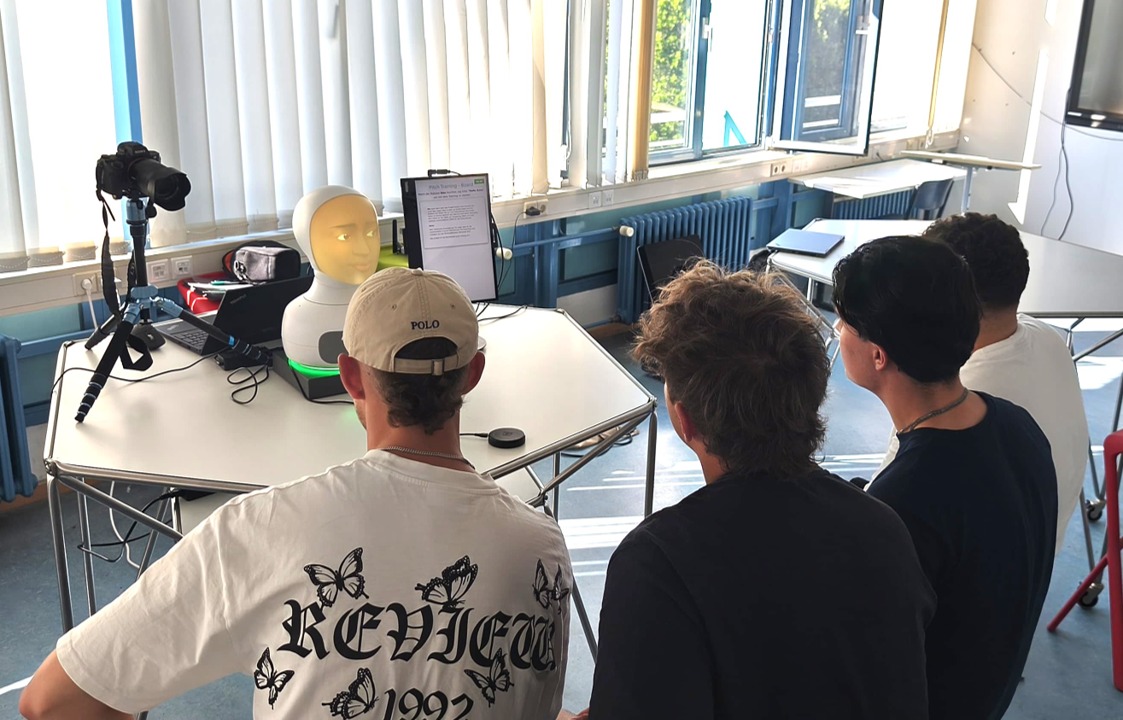
Although the findings are preliminary and the study involved a relatively small group, the results provide some encouraging results for developing more pedagogically informed human-robot interactions in educational contexts. Rather than functioning only as information providers or feedback tools, AI-powered social robots can be also used to stimulate curiosity and critical thinking.
Read the paper: https://doi.org/10.1007/978-3-032-37979-5_23
Kouayim Bonga, G.A., Buchem, I., Pinkwart, N. (2027). Curiosity-Eliciting Questioning Strategies for Robot-Assisted Pitch Training: Effects on Learning Outcomes. In: Weidlich, J., et al. Mindful TEL: Learning Technologies Shaped with Intention. EC-TEL 2026. Lecture Notes in Computer Science, vol 16905. Springer, Cham.